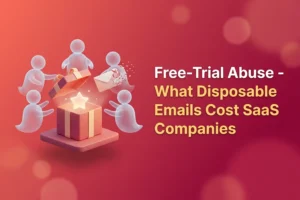
Free trial abuse is what happens when one person becomes twenty “new customers” by signing up over and over with throwaway email addresses. Each account burns a fresh trial, and the cost hides in places you don’t check daily: compute bills, API credits, support queues, and analytics that quietly stop telling the truth. There is no single setting that fixes it. The fix is layered, and the first layer is catching disposable addresses at the moment of signup.
Here’s how the abuse works, where the money actually goes, and how to shut most of it down without punishing honest users.
How trial farming actually works
A disposable email service (also called temp mail) gives anyone a working inbox in seconds. No registration, no password. You open the site, and there’s an address that receives mail for ten minutes or an hour, then vanishes. That is all it takes to pass your “confirm your email” step.
The loop looks like this:
- Open a temp-mail site and copy the address it generates.
- Sign up for your trial, click the confirmation link that lands in the disposable inbox.
- Use up whatever the trial gives away: credits, exports, sending allowance.
- When it runs out, mint a new address and start over.
Done by hand, that’s a few minutes per account. Add basic automation (a script filling your form with generated names) and one operator produces hundreds of “users” in an afternoon. Many disposable providers even offer their own APIs, which is a strange thought: there is tooling on both sides of this fight.
There’s a softer variant too, worth naming without moralizing. Some trial abusers are otherwise-normal users who simply don’t want to pay yet. They liked your product enough to come back four times, each time with a different address. No scripts, no malice. Just people cycling trials instead of converting. We’ve broken down how these throwaway addresses work, and where else they show up, in why disposable emails hurt your business.
Either way, the mechanics are identical: your email address is the account identity, and disposable email makes identities free.
What free trial abuse actually costs
Every SaaS product bleeds differently here, so instead of quoting some universal statistic (there isn’t a trustworthy one), here is where the money actually goes. Check each item against your own product.
Direct resource burn. Every trial account consumes real resources: compute, storage, third-party API calls you pay for, whatever allowance your free tier includes. You priced that giveaway assuming some fraction of trials convert and their revenue covers the rest. Farmed accounts break the math. To make it concrete with a deliberately made-up example: if the credits in your trial cost you $2 in infrastructure to serve, one person cycling thirty disposable signups takes $60 of service and was never going to pay a cent.
Support time on accounts that will never pay. Trial users file tickets, ask onboarding questions, request calls. Your team cannot tell a future customer from a fifth-time trial cycler, so both get the same care. That time costs money even when the answer is a saved reply.
Poisoned analytics. This one compounds. Your trial-to-paid conversion rate looks worse than it really is, because the denominator is stuffed with signups that were never prospects. Cohort analyses get polluted the same way. And if you run paid acquisition with the ad platform optimizing toward “started a trial,” the algorithm happily learns to find more of whatever produced those conversions, including junk traffic. You end up paying to acquire abusers more efficiently.
Abuse at scale. Past the casual end sits an actual economy: farmed accounts get resold, referral bonuses and promo credits get harvested, and free-tier quotas get pooled into something commercial. If your trial hands out anything with resale value (credits, seats, API quota) assume someone has thought about harvesting it.
The sneaky one: your own emails start bouncing. Disposable inboxes die within minutes or hours. Your welcome email, the day-three onboarding tip, the “trial expiring soon” nudge: all of it goes to addresses that no longer exist, and it comes back as hard bounces. Mailbox providers watch your bounce rate closely, and when it swells, deliverability suffers for everything you send, including mail to real paying customers. The mechanics are covered in what happens when you send email to an invalid address. Trial abuse doesn’t just waste resources; it chips away at your sending domain.
Why the obvious fixes underperform
Most teams reach for one of four tools first. Each helps less than it looks.
Static disposable-domain blocklists rot. Public lists of temp-mail domains exist, and blocking them feels like a solution for about a month. Disposable providers exist to evade exactly these lists, so they register fresh domains constantly. That’s their product. A list that was accurate last quarter misses the domains minted this week, and those are precisely the ones abusers use.
Requiring a credit card works, at a price. Card-required trials do stop most abuse. They also turn away a large share of legitimate prospects who won’t hand over a card just to look around, and they skew your conversions toward people who forgot to cancel, which is its own trust problem. For a product with a very expensive trial, the trade can be right. For most self-serve SaaS, killing top-of-funnel signups to stop abuse is amputation as a cure for a splinter.
CAPTCHAs solve a different problem. A CAPTCHA separates humans from scripts. A human cycling temp-mail addresses passes it every single time. It trims the automated end and does nothing about the rest.
Banning by IP punishes the wrong people. Block an abuser’s IP and you may have just blocked a university dorm, a coworking space, or a mobile carrier’s shared gateway. Meanwhile the actual abuser switches to a VPN in seconds. IP has some value as a signal in aggregate; as a blunt banning tool it creates more support tickets than it prevents abuse.
The layered fix
No single layer stops trial abuse. But layers stack, and each one raises the effort a fake account costs.
1. Catch disposable addresses at the signup form, dynamically. The difference between a blocklist and real-time verification is freshness: verification checks the address live, at the moment of signup, against detection that updates continuously, so newly minted throwaway domains get caught rather than just last year’s list. Reoon’s email verification API does this check in roughly half a second (fast enough that a legitimate user never notices) and flags disposable, invalid, and fake-pattern addresses in one call. There’s a practical walkthrough in our guide to stopping fake email signups.
2. Audit the user base you already have. Before deciding how big a problem this is for you, measure it. Export your existing users and run the list through bulk email verification. The percentage that comes back disposable is your baseline: the abuse that already happened. Some products find almost nothing. Others find a number that reframes their conversion metrics entirely. Either answer is worth having.
3. Gate the expensive things, not the whole product. You don’t need to wall off the entire trial. Let anyone look around, then put the costly actions (credits, exports, sending features, API keys) behind a verified address or a small dose of friction. Abusers came for the expensive things. Honest evaluators mostly came to look first, and they’ll accept a quick verification step once they want more.
4. Watch signup patterns for the automated end. Bursts of registrations in tight time windows. Sequential or template-generated names (jake1991, jake1992, jake1993). Many accounts sharing one device fingerprint. You don’t need a fraud team; simple alerts on these patterns catch the crude automation that slips past everything else.
One honest caveat: a determined abuser with a stack of real Gmail addresses will get through all of this. That’s fine. The goal was never perfection. The goal is making a fake account cost more effort than one trial is worth, because most abuse is opportunistic, and opportunists leave when the free thing stops being effort-free.
Start by measuring
Everything above gets easier once you know your real number. The disposable share of your current user base is one bulk verification away, and it tells you whether trial abuse is a rounding error for your product or a line item. Reoon Email Verifier gives you free daily verification credits with no card required, enough to check a sample of your user list today and see your actual disposable percentage before you change anything.
FAQ
How common is free-trial abuse?
It varies too much for any universal number to mean anything, so be suspicious of articles quoting one. Abuse tracks the resale value of what your trial gives away: products handing out credits, sending allowances, or API quota get farmed hard, while a tool with no per-use cost mostly sees casual trial cycling. The only number that matters is yours: verify your existing user list and look at the disposable percentage.
Should I require a credit card for trials?
It’s a trade, not a fix. A card requirement blocks most abuse but also filters out many legitimate evaluators and biases your revenue toward forgotten cancellations. If each trial costs you real money in compute or third-party fees, the trade may favor cards. If growth depends on low-friction signups, verifying addresses and gating expensive features usually loses you far fewer genuine prospects.
Do disposable email blockers stop trial abuse?
Static blockers, meaning a downloaded list of temp-mail domains, stop last year’s abuse. Disposable providers mint new domains specifically to escape those lists. Dynamic detection through a real-time verification API catches new domains as they appear, which closes most of that gap. Neither stops a human using genuine addresses, which is why gating and pattern-watching exist as separate layers.
Can I detect trial abusers already in my user base?
The disposable-email portion, yes. Export your users and run the list through bulk verification: every address flagged as disposable is a signup that could never have become a customer. That’s your historical abuse baseline. Pruning those accounts also cleans up your metrics and stops onboarding emails from bouncing off dead inboxes.