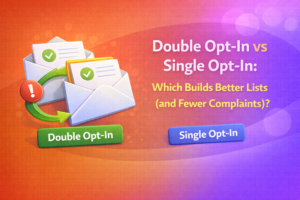
Everybody wants a bigger email list. Very few people stop and ask the more useful question: Do I want a bigger list… or a better one?
That’s really what the single opt-in vs double opt-in debate is about.
One helps you grow faster. The other usually gives you cleaner data, better engagement, and fewer future headaches.
If you run a SaaS, a newsletter, or any kind of lead capture flow, this choice matters more than it first appears. It affects list quality, conversion rate, spam complaints, deliverability, and even how much trust your team has in the leads you collect.
In this guide, I’ll break it down in plain English so you can choose the right setup for your business—not just copy what everyone else is doing.
The short answer
- Single opt-in usually grows your list faster because there’s less friction.
- Double opt-in usually builds a cleaner, more engaged list with fewer complaints.
- If your priority is list quality and long-term deliverability, double opt-in usually wins.
- If your priority is the smoothest possible signup flow, single opt-in can work well—but only if you pair it with good list hygiene and real-time validation.
Simple rule: Single opt-in usually gets you more addresses. Double opt-in usually gets you better addresses.
What is single opt-in?
Single opt-in means someone enters their email address once, submits the form, and is added to your list immediately.
That’s it. No extra confirmation step.
This is why single opt-in feels frictionless. It’s fast, simple, and good for conversion rate at the top of the funnel.
Example: Someone downloads your lead magnet, signs up for your newsletter, or starts a SaaS trial—and their email goes straight into your system.
What is double opt-in?
Double opt-in means someone enters their email address, then receives a confirmation email and must click a link to confirm before they’re fully subscribed.
You’ll also hear this called confirmed opt-in.
This extra step creates a small amount of friction—but it also acts like a filter. People who confirm are more likely to be real, interested, and reachable.
Example: Someone signs up for your newsletter, gets a confirmation email, clicks “Confirm my subscription,” and only then becomes an active subscriber.
Single opt-in vs double opt-in: side-by-side
| Factor | Single Opt-In | Double Opt-In |
|---|---|---|
| Signup friction | Lower | Higher |
| Raw list growth | Usually faster | Usually slower |
| List quality | More mixed | Usually cleaner |
| Typos / wrong emails | More likely to get through | Often filtered out because they never confirm |
| Disposable / low-intent signups | More likely | Usually lower |
| Engagement quality | More uneven | Usually better |
| Complaint risk | Usually higher | Usually lower |
| Best fit | Fast signup flows, SaaS activation, low-friction conversion | Newsletters, content subscriptions, high-quality lead capture |
Why double opt-in usually builds better lists
Let’s start with the good stuff.
Double opt-in usually creates a healthier list for a very simple reason:
it forces a second moment of intent.
That one extra click filters out a surprising amount of junk.
1) It removes some accidental signups
People type the wrong address. They use an old inbox. They sign up and immediately forget.
With single opt-in, those contacts still enter your list. With double opt-in, many of them never confirm—so they never become active subscribers.
2) It reduces low-intent subscribers
Some people just want the free thing, the coupon, or the trial. They’re curious, but not serious.
Double opt-in tends to keep the people who are at least willing to take one extra step. That usually improves engagement later.
3) It creates a cleaner permission trail
If complaints happen, double opt-in gives you a stronger case that the person really intended to join the list.
That doesn’t make it a magic shield—but it does make your consent story stronger.
4) It usually leads to fewer complaints
People are less likely to mark your emails as spam when they clearly remember confirming the subscription.
And fewer complaints usually means better long-term deliverability.
Where double opt-in loses
Of course, it’s not perfect.
The biggest downside is simple:
You will lose some real people.
Not because they hated your brand. Usually because:
- they got distracted
- they missed the confirmation email
- it landed in promotions/spam
- they intended to confirm later and never came back
So if your only success metric is “how many emails did we collect,” double opt-in can look worse.
But if your real metric is “how many reachable, engaged people did we collect,” the story usually flips.
Why single opt-in is still a smart choice in some cases
Single opt-in is not “bad.” It’s just more demanding behind the scenes.
It works best when speed and simplicity matter a lot.
1) SaaS signups often need low friction
If someone is starting a free trial or creating an account, every extra step can reduce activation.
In product-led SaaS, that matters. You may not want to slow account creation just to make your list cleaner.
2) Some flows are time-sensitive
If someone wants instant access to a resource, demo, or product, a confirmation step can feel like a speed bump.
3) You may already have other filters in place
If you use real-time validation, welcome emails, suppression rules, and regular list cleaning, single opt-in can perform just fine.
The problem is not single opt-in itself.
The problem is single opt-in with no cleanup, no validation, and no sending discipline.
Which one builds better lists?
Here’s the honest answer:
- Double opt-in builds the better list if “better” means cleaner, more engaged, and lower-risk.
- Single opt-in builds the better list if “better” means bigger and faster-growing.
So the real question is not “Which is universally better?”
It’s:
Which kind of “better” matters more to your business right now?
What should newsletters choose?
For most newsletters, content brands, and media-style email lists, I’d lean toward double opt-in more often than not.
Why?
- deliverability matters a lot
- engagement matters a lot
- complaints hurt
- vanity subscriber count is less useful than a genuinely interested audience
If your newsletter business depends on reaching the inbox consistently, a smaller but more engaged list is often the smarter asset.
That said, if you’re in aggressive growth mode, single opt-in can still work—just make sure you’re validating emails in real time and cleaning the list regularly.
What should SaaS choose?
For SaaS, the answer is more nuanced.
If your top priority is getting users into the product quickly, single opt-in is often the better choice for account creation.
But that doesn’t mean “do nothing.”
A smarter SaaS setup often looks like this:
- Use single opt-in for signup/access
- Validate the email in real time during signup
- Send a welcome or confirmation email immediately
- Require email confirmation for certain actions if needed
- Clean your database regularly before marketing campaigns
This gives you a smoother product experience without letting junk pile up in your system.
What should lead gen choose?
If you run lead forms, paid ads, demo requests, or downloadable resources, the answer usually depends on lead quality vs volume.
- If your sales team is drowning in junk leads, lean more toward double opt-in or a stricter hybrid.
- If speed-to-lead matters more than perfect list quality, single opt-in can work—but you need stronger validation.
Paid acquisition especially makes bad emails expensive. If you’re paying for leads, low-quality addresses don’t just hurt deliverability—they hurt ROI.
If this is a pain point for your team, these internal posts fit nicely here:
- Disposable Emails: Why They Hurt SaaS, Newsletters, and Lead Gen
- Email List Cleaning Checklist: The Exact Steps to Do Before You Send
The hybrid approach many teams end up using
If you don’t love either extreme, here’s the middle ground that works really well:
Use low-friction signup, but keep your main marketing list stricter
That can look like this:
- User signs up once (single opt-in experience)
- You validate the email in real time
- You let the user access the product/resource immediately
- You send a welcome/confirmation email
- You treat confirmed or engaged contacts as your “best” marketing segment
This gives you the conversion benefits of single opt-in and some of the quality benefits of double opt-in.
It’s not perfect, but it’s often the most practical setup.
Important reality check: opt-in type won’t save a bad acquisition source
This part matters.
If your traffic source is poor, your lead magnet attracts low-intent users, or your form is getting abused by bots, the opt-in type alone won’t fix everything.
Double opt-in can reduce the damage. But it won’t magically turn weak acquisition into high-quality subscribers.
That’s why opt-in strategy works best when combined with:
- better lead sources
- real-time validation
- suppression lists
- regular list cleaning
- clear unsubscribe options
Where Reoon helps (whichever opt-in model you choose)
Reoon Email Verifier doesn’t replace opt-in consent. That’s important. Opt-in handles permission. Verification handles email quality and risk.
What Reoon can do is make either model safer and cleaner.
For example:
- At signup: use Reoon’s live API validation to check emails in real time and reduce obviously bad or disposable entries.
- Before campaigns: use bulk verification to clean your existing list before sending.
- After verification: segment results so you send to safer contacts first and handle risky groups more carefully.
This is especially useful if you choose single opt-in and want to keep the friction low without letting bad data pile up.
If you want a good companion post for beginners, link this internally:
Email Verification 101: What It Is, Why It Matters, and How It Works
My practical recommendation
If you want the simplest advice I can give:
- Choose double opt-in for newsletters and list-quality-first brands.
- Choose single opt-in for SaaS/product signup flows where friction hurts activation.
- Use a hybrid if you want speed and stronger list quality.
- Use verification either way, because bad emails don’t care which opt-in model you picked.
Free registration (no card required): Create your Reoon account
FAQ
Does double opt-in always reduce signup numbers?
Usually, yes. Some real people won’t complete the confirmation step. But the people who do confirm are often more engaged and lower-risk, which can make the list healthier overall.
Is single opt-in bad for deliverability?
Not automatically. Single opt-in can work well if you validate emails in real time, clean your list regularly, and avoid sending to stale or risky contacts. The problem is poor hygiene, not just the opt-in method.
Does double opt-in stop disposable emails?
Not completely. Some disposable inboxes can still receive confirmation emails. Double opt-in reduces junk, but it doesn’t replace email verification and list cleaning.
Which is better for SaaS free trials?
Often single opt-in is better for the actual signup flow because it reduces friction. Then you can use verification, welcome emails, and later confirmation rules to improve list quality without hurting activation.
Can email verification replace double opt-in?
No. They do different jobs. Double opt-in helps confirm intent and consent. Email verification helps assess whether the address is real, reachable, and risky or not. The strongest setup usually combines both where appropriate.
What if complaints are already a problem?
If spam complaints are rising, moving toward double opt-in—or at least a stricter hybrid—can help. Also review your list sources, unsubscribe experience, and list-cleaning process, because complaints usually come from a bigger list-quality issue.